
The Digital Pack: Using Multi-Pet AI Tracking Apps to Manage Shared Health and Activity Goals

The Digital Pack: Using Multi-Pet AI Tracking Apps to Manage Shared Health and Activity Goals

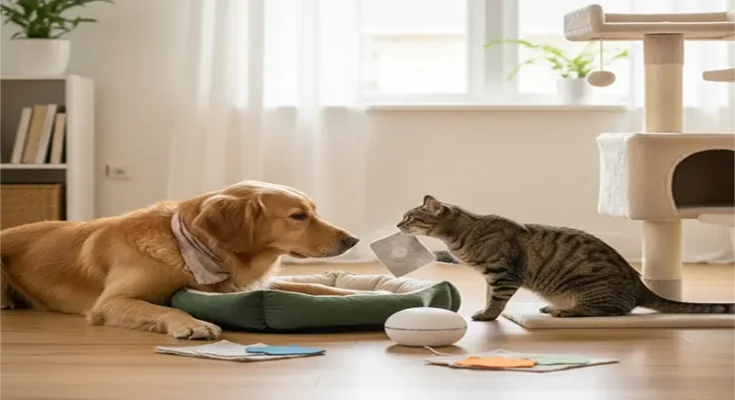
For households with multiple pets, the logistics of care can quickly become a full-time job. From juggling vaccination schedules for three different dogs to monitoring the subtle health shifts in an aging cat, manual tracking often leads to fragmented information and missed opportunities for early intervention. The rise of AI-integrated pet health ecosystems is fundamentally changing this dynamic, transforming the “multi-pet household” from a chaotic juggling act into a synchronized, data-driven operation.

The Evolution of the ‘Smart’ Household

Historically, pet management relied on a mixture of mental notes, paper calendars, and memory—a system prone to human error, especially in busy households. The modern era of pet care has shifted toward centralized AI dashboards. These platforms do more than just store files; they act as a “digital pack leader,” consolidating disparate streams of data into a single, cohesive view. By integrating wearable sensors, smart home cameras, and user-provided health logs, these AI systems create a comprehensive digital twin for every pet in your home.

Key Features of Multi-Pet AI Ecosystems

To be effective, a multi-pet AI platform must handle complexity with simplicity. Essential features include:

  • Centralized Profile Management: Every pet gets a dedicated digital identity storing medical histories, vaccination due dates,
The Digital Pack: Using Multi-Pet AI Tracking Apps to Manage Shared Health and Activity Goals Read More
Best Furniture and Vertical Space Solutions for a Harmonious Multi-Pet Household

Best Furniture and Vertical Space Solutions for a Harmonious Multi-Pet Household

In a multi-pet household, the home is more than just a living space—it is a complex ecosystem. When multiple species share the same square footage, stress often arises not from personality clashes, but from a struggle for territory and resources. To foster true harmony, we must rethink our interiors through the lens of animal behavior and environmental design.

The Science of Territory

At the heart of pet conflict lies the Resource Dispersion Theory. This ecological concept suggests that the way essential resources—food, water, resting spots, and safe zones—are distributed dictates how animals share space. In our homes, if all resources are clustered in one area, dominant pets can easily monopolize them, causing “resource guarding” and anxiety in others.

To mitigate this, we must disperse resources. By strategically placing multiple stations throughout the home, we reduce the need for pets to compete. Furthermore, we must address the “vertical territory.” While dogs are largely terrestrial, cats are arboreal; they experience their environment in three dimensions. Providing height is not a luxury—it is a physiological necessity that allows cats to monitor their domain from a position of safety, effectively diffusing potential conflicts with canine or feline housemates.

Vertical Engineering for Cats

A …

Best Furniture and Vertical Space Solutions for a Harmonious Multi-Pet Household Read More
The Smiling Monk of the Apartment: Why the Chartreux is the Ultimate Quiet Companion for 2026

The Smiling Monk of the Apartment: Why the Chartreux is the Ultimate Quiet Companion for 2026

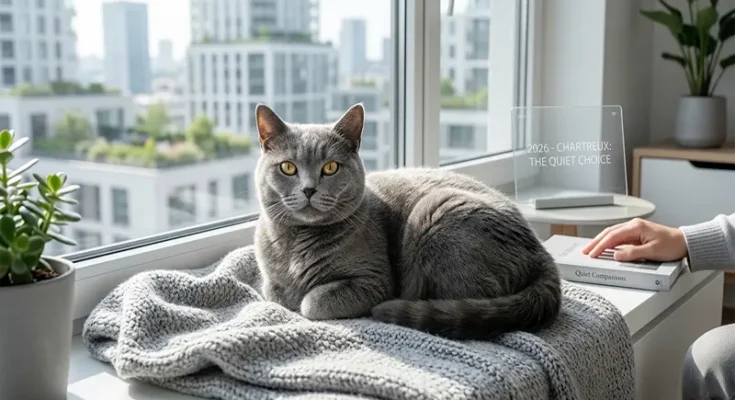
In the fast-paced, hyper-connected world of 2026, the modern apartment has become more than just a living space; it is our sanctuary—a place to decompress from the digital noise of the day. For the urban dweller, the search for a pet often hinges on a delicate balance: the need for deep, meaningful companionship without the chaos, constant vocalization, or high-maintenance needs that can turn a small living space into a source of stress. Enter the Chartreux, the “Smiling Monk” of the feline world. With its tranquil energy, plush woolly coat, and legendary quietude, the Chartreux is arguably the most sophisticated companion for apartment living in the current era.

The Monastic Vow of Silence

The history of the Chartreux is as refined as its personality. Legend whispers that the breed was cultivated by Carthusian monks in France, who sought a cat that could share their cloistered, contemplative existence. Whether the legend is entirely factual or a romanticized origin, the breed certainly carries the trait of a contemplative soul.

In a world where many cats are prone to demanding, persistent meowing, the Chartreux is a model of discretion. They are rarely silent—they communicate through soft, endearing chirps and gentle murmurs—but they lack …

The Smiling Monk of the Apartment: Why the Chartreux is the Ultimate Quiet Companion for 2026 Read More
The Island Cat of the North: Everything You Need to Know About the Rare Kurilian Bobtail Longhair

The Island Cat of the North: Everything You Need to Know About the Rare Kurilian Bobtail Longhair

In the remote, windswept reaches of the Kuril Islands—a chain of volcanic outcrops stretching between the Russian Far East and Japan—a cat has thrived in relative isolation for centuries. This is the Kurilian Bobtail, a natural-born adventurer that feels more like a miniature, feline-clad legend than a typical house cat. With a pom-pom tail that acts as a unique fingerprint and a spirit as rugged as the islands from which they hail, the Kurilian Bobtail Longhair is one of the cat world’s best-kept secrets.

A Natural Wonder: Born of the Wild

Unlike many breeds that have been meticulously sculpted by human intervention over generations, the Kurilian Bobtail is a “natural breed.” They were not designed in a laboratory or bred for specific show-ring aesthetics; they evolved through natural selection in a harsh, cold environment. For centuries, they lived alongside humans on the islands, serving as highly skilled rodent hunters and companions. It wasn’t until the mid-20th century, when Russian researchers and military personnel returned to the mainland with these cats, that the world began to realize the Kurilian was a distinct, robust, and extraordinarily resilient breed.

Physical Characteristics: The North’s Masterpiece

The longhaired variety of the Kurilian Bobtail is a …

The Island Cat of the North: Everything You Need to Know About the Rare Kurilian Bobtail Longhair Read More
The Living Fossil of the Shallows: Unique Features of the Blackchin Guitarfish and Where to Find Them

The Living Fossil of the Shallows: Unique Features of the Blackchin Guitarfish and Where to Find Them

In the murky transition zones where the ocean meets the land—the sandy estuaries, shallow bays, and quiet seagrass meadows of the Eastern Atlantic—lurks a creature that feels like a relic from another geological era. The blackchin guitarfish (Glaucostegus cemiculus) is a master of disguise, a creature whose evolutionary design blurs the lines between two of the ocean’s most iconic groups: sharks and rays. Often overlooked in favor of more charismatic megafauna, this “living fossil” offers a masterclass in adaptation, survival, and the hidden wonders of our coastal seas.

Anatomy of an Evolutionary Hybrid

The blackchin guitarfish is classified within the order Rhinopristiformes, a group of batoid fishes that are frequently referred to as “shovelnose rays.” To the untrained eye, they are a biological contradiction. Their posterior half looks distinctly shark-like, featuring a powerful tail and prominent dorsal fins, while their anterior half is flattened into a disc-like shape reminiscent of a ray.

Their most distinctive feature—and the source of their common name—is the dark, charcoal-colored blotch located on the ventral (underside) surface of their snout. Unlike the more uniform coloration of other guitarfish species, this “black chin” provides a reliable diagnostic marker for researchers and divers alike. Their …

The Living Fossil of the Shallows: Unique Features of the Blackchin Guitarfish and Where to Find Them Read More