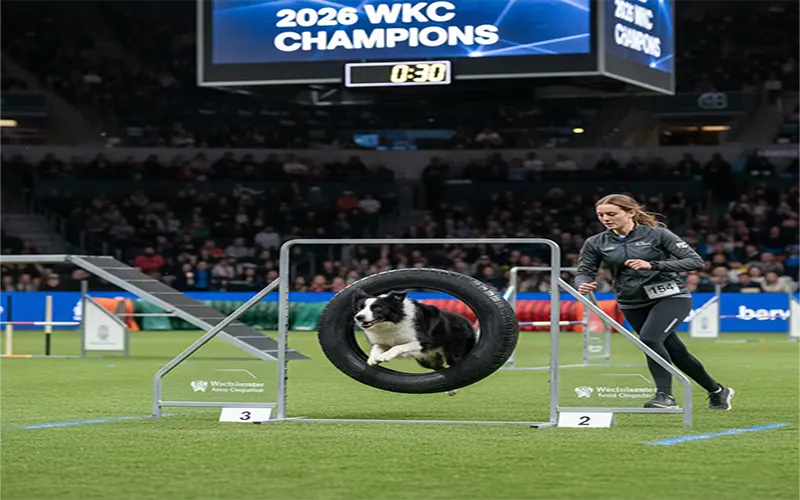
The landscape of professional dog agility has shifted dramatically. At the 2026 World Kennel Club (WKC) Championships, the podium was dominated by teams displaying a level of synchronization and biomechanical efficiency that makes previous years’ standards look almost sluggish. For the modern Border Collie—a breed already synonymous with agility—this evolution is not about moving faster; it is about moving smarter.
Modern success is defined by the reduction of “unnecessary airtime” and the mastery of tight, committed handling lines.
The Biomechanics of Speed: Beyond Stride
The 2026 WKC champions demonstrated that speed is a byproduct of efficient force production. In top-tier competition, the goal is to optimize the dog’s center of gravity during high-velocity maneuvers.
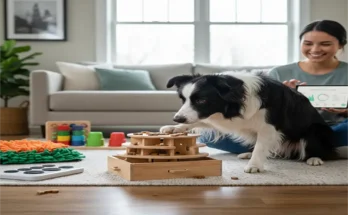
To achieve the “explosive pivot” seen in the winning rounds, handlers are moving away from traditional looping turns. Instead, they focus on rear-drive engagement. By training the dog to load their hocks and push off from the rear, rather than breaking stride to pivot on the front shoulders, dogs can maintain a “tight” radius. This is achieved through targeted exercises like platform work, where the dog learns to keep their rear feet stationary while shifting their front end, effectively teaching them to “thread” their own body through tight spaces without drifting.
Advanced Handling: Calling vs. Sending
The defining characteristic of the 2026 championship handlers was their ability to communicate intent milliseconds before the dog reached an obstacle. This is the distinction between “calling” and “sending.”
“Sending” a dog—relying on a directional cue from a distance—requires immense trust and a clear, unwavering path. The WKC finalists utilized Blind Crosses to shift their dog’s line of travel without ever breaking eye contact or hindering the dog’s momentum. Unlike a Front Cross, which can act as a speed bump if timed poorly, a well-executed Blind Cross allows the handler to move ahead of the dog, pulling the dog’s line into a tighter arc.
The winning handlers prioritized “obstacle commitment,” ensuring the dog had “locked on” to the next pipe or contact zone before the handler initiated their next movement. This prevents the “searching” behavior often seen in less experienced teams.
Mental Conditioning and High-Pressure Focus
Maintaining a Border Collie’s “drive” in a stadium environment—with thousands of spectators and high-frequency auditory distractions—is the ultimate test of the handler-dog bond. The 2026 champions utilized “engagement protocols” in the warm-up ring that mimicked the intensity of the competition floor.
The strategy is simple: High-Value Predictability. By keeping the reward system consistent (often using specific high-value toys only during training sessions that mimic competition tension), handlers ensure the dog associates the high-pressure environment with the same dopamine-fueled excitement they feel during simple play.
Conditioning for Longevity
The physical toll of this level of agility is immense. High-drive Border Collies are prone to soft-tissue injuries, particularly in the shoulders and iliopsoas. The 2026 gold medalists were notable for their rigorous eccentric loading programs.
Exercises like controlled uphill/downhill backing and proprioceptive balance work on stability equipment ensure the dog’s stabilizers are as strong as their primary movers. By focusing on core integrity, these dogs were able to execute 180-degree pivots at full gallop with minimal risk to their joints. Longevity is the true hallmark of a champion; the most successful teams of 2026 were those that treated their Border Collies as professional athletes, incorporating physiotherapy as standard practice alongside hurdle training.