

The Living Fossil of the Shallows: Unique Features of the Blackchin Guitarfish and Where to Find Them
In the murky transition zones where the ocean meets the land—the sandy estuaries, shallow bays, and quiet seagrass meadows of the Eastern Atlantic—lurks a creature that feels like a relic from another geological era. The blackchin guitarfish (Glaucostegus cemiculus) is a master of disguise, a creature whose evolutionary design blurs the lines between two of the ocean’s most iconic groups: sharks and rays. Often overlooked in favor of more charismatic megafauna, this “living fossil” offers a masterclass in adaptation, survival, and the hidden wonders of our coastal seas.
Anatomy of an Evolutionary Hybrid
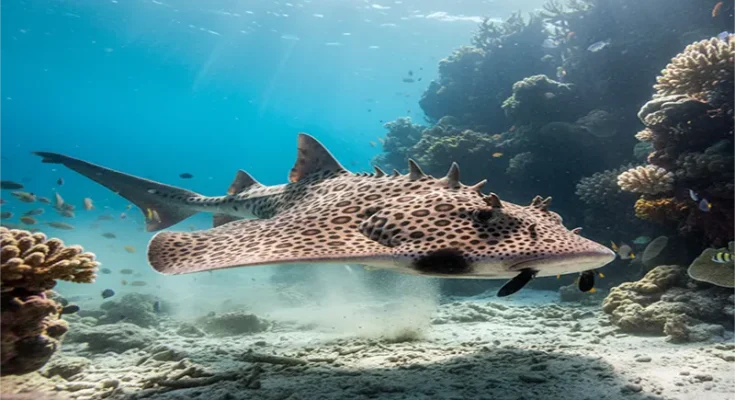
The blackchin guitarfish is classified within the order Rhinopristiformes, a group of batoid fishes that are frequently referred to as “shovelnose rays.” To the untrained eye, they are a biological contradiction. Their posterior half looks distinctly shark-like, featuring a powerful tail and prominent dorsal fins, while their anterior half is flattened into a disc-like shape reminiscent of a ray.
Their most distinctive feature—and the source of their common name—is the dark, charcoal-colored blotch located on the ventral (underside) surface of their snout. Unlike the more uniform coloration of other guitarfish species, this “black chin” provides a reliable diagnostic marker for researchers and divers alike. Their …
The Living Fossil of the Shallows: Unique Features of the Blackchin Guitarfish and Where to Find Them Read More