Introducing a dog and a cat is an exercise in managing biological instincts. While humans tend to prioritize visual interaction, dogs and cats primarily map their world through their sense of smell. When an introduction fails, it is almost always because the “olfactory map” of the home was disrupted too abruptly, leading to fear, territorial aggression, or predatory hyper-fixation. By focusing on scent-swapping and pheromone integration, you can essentially “introduce” your pets long before they ever lock eyes.
The Olfactory First Impression
In the world of canines and felines, smell is the primary language. A cat’s facial pheromones communicate comfort and belonging, while a dog’s scent profile communicates hierarchy, health, and emotional state. When you bring a new pet home, they enter a territory already saturated with another animal’s “signature.” If they meet face-to-face immediately, their primary instinct is to defend that territory. By starting with scent, you allow them to build a “familiarity index” in their brains, turning the other animal from an “intruder” into a “known resident.”
Scent-Swapping Protocols
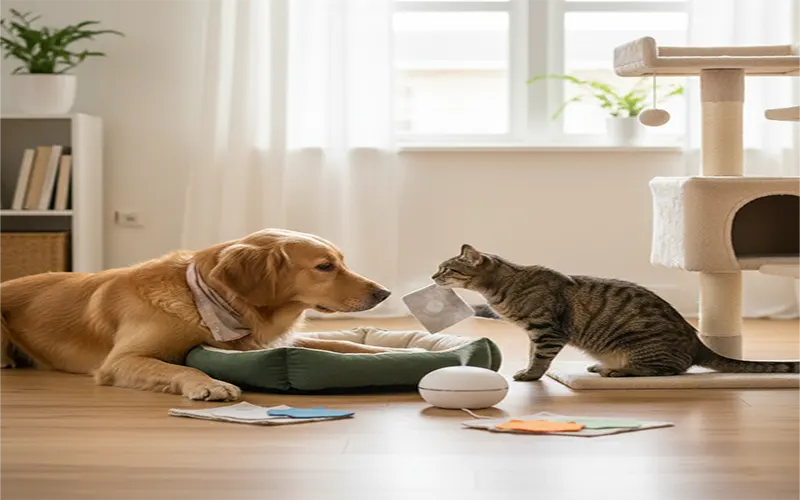
Scent-swapping is the process of physically moving the “odor” of one animal into the space of the other.
- Preparation: Use clean, soft cloths (one for the cat, one for the dog).
- The Swab: Gently rub the cat’s cloth against their cheeks, chin, and temples, where their soothing facial pheromones are concentrated. For the dog, rub the cloth against the base of the tail and the flanks, where individual identifying scents are strongest.
- The Exchange: Place the cat’s scent cloth in the dog’s area and vice versa.
- Positive Reinforcement: Offer high-value treats or meals near these cloths. The goal is to create a positive neurological association: “The scent of this stranger precedes something good.”
The Science of Pheromone Therapy
Synthetic pheromones are a game-changer for high-stress introductions.
- Feliway (Cats): Mimics the F3 fraction of facial pheromones, which cats use to mark their territory as “safe.”
- Adaptil (Dogs): Mimics the dog-appeasing pheromone (DAP) naturally released by nursing mothers to soothe puppies.
These products are not “tranquilizers”; they are biological signals that downregulate the amygdala—the brain’s fear center. For maximum efficacy, place diffusers in the rooms where your pets spend the most time, specifically at the “neutral” boundaries where you intend to conduct future visual introductions.
Gradual Exposure and ‘Neutral’ Territory
Beyond scent, you must manage the physical layout of the home. This is often referred to as “site-swapping.”
- The Rotation: While one pet is securely crated or in a separate room, allow the other to explore the living space, smell the furniture, and interact with the scent-swapped cloths. This builds confidence.
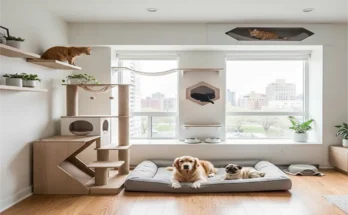
- Verticality: Ensure the cat has clear “escape routes”—tall cat trees or shelving units—that allow them to view the dog from a position of absolute safety.
- The Barrier: Never conduct the first “meeting” in the open. Use a secure baby gate or a glass-panel door. This allows them to see each other (visual mapping) without the risk of an aggressive encounter.
Monitoring for Red Flags
Introduction is a slow, iterative process. If you observe any of the following, you have moved too quickly:
- Fixed Gaze: The dog or cat stares unblinkingly at the other. This is the precursor to predatory behavior.
- Tension/Stiffness: A cat with a puffed tail and flattened ears, or a dog with a stiff, high tail and closed mouth, is in a state of high arousal.
- Hyper-fixation: If your dog cannot be “called away” from the cat with a high-value treat, they are over threshold and need to be removed from the situation immediately.
If these behaviors occur, reset the clock. Go back to scent-swapping and pheromone diffusers for another 48 hours before attempting another visual trial. By respecting the biological pace of your pets, you aren’t just preventing a fight; you are building the foundation for a peaceful, long-term co-existence.