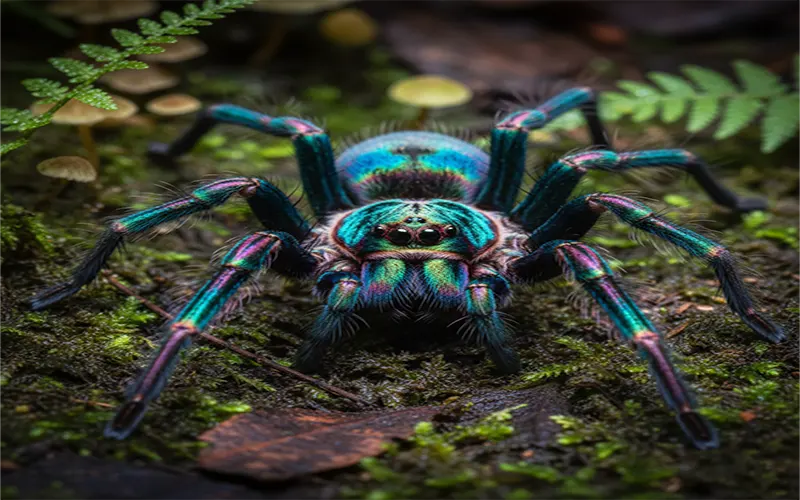
Imagine a creature born from a forgotten dream, its exoskeleton not merely reflecting light but fracturing it into a kaleidoscopic display of electric blues, vivid purples, and emerald greens that shift with every subtle movement. This is no myth, but the Iridescent Psychedelic Earth Tiger (Chilobrachys natanicharum), a tarantula that emerges from the hidden depths of Thailand’s ancient forests to claim its rightful place as one of the natural world’s most breathtaking and elusive arachnids. Its name alone whispers of its exotic allure, a moniker perfectly suited to a spider whose beauty seems almost otherworldly.
The Science of the Shimmer: Nature’s Optical Illusion
What gives the Psychedelic Earth Tiger its mesmerizing, ever-changing palette? The answer lies not in pigments, like the reds of a rose or the browns of soil, but in an intricate feat of biological engineering known as structural coloration. Unlike pigments, which absorb certain wavelengths of light and reflect others, structural coloration relies on microscopic physical structures to scatter, refract, and interfere with light waves.
On the fine setae (hairs) covering this tarantula’s body, scientists have discovered nanostructures—tiny, precisely arranged ridges and layers—that are perfectly spaced to manipulate light. When white light hits these structures, specific wavelengths are amplified, creating the intense, iridescent blues and greens that shimmer across its form. As the spider moves, or as the angle of light changes, these microscopic prisms realign, causing the colors to dance and shift, creating that truly “psychedelic” effect. It’s a living optical illusion, a testament to evolution’s boundless creativity, crafting beauty not from chemical dyes but from the very fabric of light itself.
Habitat and Elusiveness: A Ghost in the Jungle
The natural realm of the Iridescent Psychedelic Earth Tiger is deeply intertwined with the lush, humid tropical forests of Thailand. These tarantulas are masters of concealment, preferring to live underground in meticulously constructed burrows. These subterranean fortresses provide protection from predators, stable temperatures, and a perfect ambush point for unsuspecting prey. Their reclusive nature, coupled with the dense, often impenetrable forest environment, makes encounters with them incredibly rare.
For researchers, studying Chilobrachys natanicharum is a monumental challenge. Locating their camouflaged burrows requires immense patience and an intimate understanding of their preferred microhabitats. They are often only glimpsed during nocturnal excursions when they might briefly venture out of their silk-lined tunnels to hunt or find a mate. This elusiveness only adds to their mystique, transforming each sighting from a mere observation into a profound privilege, a fleeting connection with one of nature’s most hidden gems. Their existence reminds us that even in well-explored corners of the world, astonishing wonders remain cloaked in shadow and mystery.
Behavioral Fascination: Beauty with a Bite
Despite their dazzling appearance, the Psychedelic Earth Tiger is, at heart, a quintessential tarantula. While they are not known for extreme aggression, they are defensive creatures, especially when threatened. Their primary defense mechanism is retreating into their burrows, but if cornered, they may display a threat posture, raising their front legs to reveal their fangs, a stark contrast to their shimmering beauty.
Like most tarantulas, they are opportunistic predators, ambushing insects and small invertebrates that wander too close to their burrow entrances. Their life cycle, from tiny slings to mature adults, unfolds largely beneath the forest floor, a silent ballet of survival dictated by instinct. It’s this dichotomy—their radiant, almost fantastical appearance coupled with their grounded, wild instincts as burrowing tarantulas—that makes them so compelling. They embody the untamed spirit of the jungle, a splash of vibrant color in an otherwise earthy world.
Conservation and Ethics: Protecting a Living Jewel
The allure of the Iridescent Psychedelic Earth Tiger, while a gift to behold, also presents significant challenges for its survival. Its stunning appearance has unfortunately made it a highly sought-after species in the exotic pet trade. Unregulated collection from the wild poses a severe threat, disrupting fragile populations and potentially driving the species towards endangerment.
Conservation efforts are therefore paramount. This involves not only protecting the spiders themselves but, more importantly, preserving their natural habitats. Deforestation, agricultural expansion, and human encroachment all chip away at the intricate ecosystems these tarantulas call home. Ethical breeding programs within the scientific community and responsible hobbyist circles can help reduce pressure on wild populations, but the long-term survival of Chilobrachys natanicharum ultimately rests on safeguarding the integrity of Thailand’s precious rainforests. Education also plays a crucial role, fostering appreciation and understanding rather than exploitation.
A Reminder of Hidden Wonders
The Iridescent Psychedelic Earth Tiger is more than just a beautiful spider; it is a living masterpiece, a testament to the endless creativity of evolution. Its structural colors, its elusive nature, and its vital role within its ecosystem all contribute to its status as one of the world’s most captivating creatures. It challenges our preconceived notions of beauty, proving that even in the often-misunderstood world of arachnids, there exists unparalleled splendor.
This radiant tarantula serves as a powerful reminder of the hidden wonders that still grace our planet—creatures that live in the shadows, their existence a quiet testament to biodiversity’s richness. To see one, even in a photograph, is to be touched by a rare magic, a fleeting glimpse into a world where science and artistry merge into something truly extraordinary. Its beauty compels us to protect not just this species, but the delicate, intricate web of life that allows such miracles to exist.