In the murky transition zones where the ocean meets the land—the sandy estuaries, shallow bays, and quiet seagrass meadows of the Eastern Atlantic—lurks a creature that feels like a relic from another geological era. The blackchin guitarfish (Glaucostegus cemiculus) is a master of disguise, a creature whose evolutionary design blurs the lines between two of the ocean’s most iconic groups: sharks and rays. Often overlooked in favor of more charismatic megafauna, this “living fossil” offers a masterclass in adaptation, survival, and the hidden wonders of our coastal seas.
Anatomy of an Evolutionary Hybrid
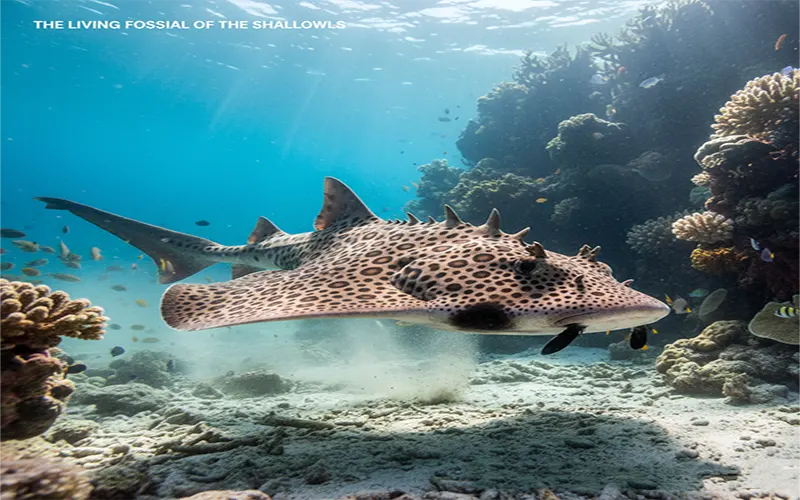
The blackchin guitarfish is classified within the order Rhinopristiformes, a group of batoid fishes that are frequently referred to as “shovelnose rays.” To the untrained eye, they are a biological contradiction. Their posterior half looks distinctly shark-like, featuring a powerful tail and prominent dorsal fins, while their anterior half is flattened into a disc-like shape reminiscent of a ray.
Their most distinctive feature—and the source of their common name—is the dark, charcoal-colored blotch located on the ventral (underside) surface of their snout. Unlike the more uniform coloration of other guitarfish species, this “black chin” provides a reliable diagnostic marker for researchers and divers alike. Their skin is typically a sandy-olive or brownish-grey, enabling them to disappear almost instantly when they settle into the seafloor substrate.
Ecological Niche: The Shallow-Water Ambush
The guitarfish’s body shape is not a random evolutionary accident; it is a specialized tool for its environment. By maintaining a flattened disc, the blackchin guitarfish can burrow effortlessly into soft, sandy, or muddy substrates, leaving only its eyes exposed to monitor the water column above.
They are apex ambush predators of the shallows. Their diet consists primarily of benthic invertebrates, including crustaceans, mollusks, and small bottom-dwelling fish. When prey wanders within striking distance, the guitarfish leverages its powerful jaw—adapted for crushing the hard shells of crabs and clams—to secure a meal with surprising speed.
Behavioral Mysteries
Despite their relatively large size, which can reach over two meters in length, these fish are notoriously difficult to track. They are semi-sedentary creatures, often remaining in the same patch of sand for extended periods. They exhibit crepuscular activity patterns, meaning they are most active during the dawn and dusk hours. Because they favor turbid, shallow waters where visibility is often low, casual snorkelers rarely encounter them. They are the “ghosts” of the estuary, perfectly content to remain hidden in the gloom.
Where to See Them: A Geographic Guide
The blackchin guitarfish occupies a range that spans the Eastern Atlantic, from the southern coasts of Portugal and Spain, down the Atlantic coast of Africa to Angola, and throughout the Mediterranean Sea.
If you are hoping to encounter one in the wild, your focus should be on their preferred micro-habitats:
- Estuaries and River Mouths: These nutrient-rich zones provide the ideal muddy substrate for burrowing.
- Seagrass Meadows: Coastal grass beds offer both protection from predators and an abundance of crustacean prey.
- Shallow Sandy Bays: In protected Mediterranean coves, they are occasionally spotted by divers moving slowly along the bottom at depths of 5 to 20 meters.
Note: As this species is critically endangered, sightings are rare. Patience, quiet movement, and environmental awareness are essential.
Conservation: The Cost of Bycatch
The blackchin guitarfish faces a dire future. Its reliance on shallow, coastal waters puts it in direct competition with human industry. They are a frequent victim of bottom-trawling—an indiscriminate fishing method that scrapes the seafloor—and incidental bycatch in artisanal gillnet fisheries. Because these fish have a slow reproductive cycle and low fecundity, their populations cannot bounce back from intensive fishing pressure. They are currently listed as Critically Endangered, making every surviving individual vital to the species’ recovery.
Ethical Wildlife Observation
If you are lucky enough to spot one, your behavior is paramount:
- Maintain Distance: Do not attempt to touch or chase the animal. A startled guitarfish will kick up a cloud of silt, causing stress and potentially causing it to abandon a high-quality hunting ground.
- Control Your Buoyancy: Avoid kicking up sediment, which degrades the habitat and ruins the water clarity for the animal.
- Report the Sighting: If you are a diver or researcher, documenting the location, depth, and size of the fish and reporting it to local marine conservation authorities can provide invaluable data for population tracking.
A Sentinel of the Coast
The blackchin guitarfish is more than just a biological curiosity; it is a sentinel of the shallow seas. Its presence in an estuary or bay is an indicator of a healthy, productive ecosystem. As we push further into our coastal frontiers, protecting the “forgotten” residents like the blackchin guitarfish becomes a litmus test for our commitment to marine conservation. To protect them is to protect the very interface of our world, ensuring that the shallow, mysterious places of our planet remain vibrant, diverse, and alive.