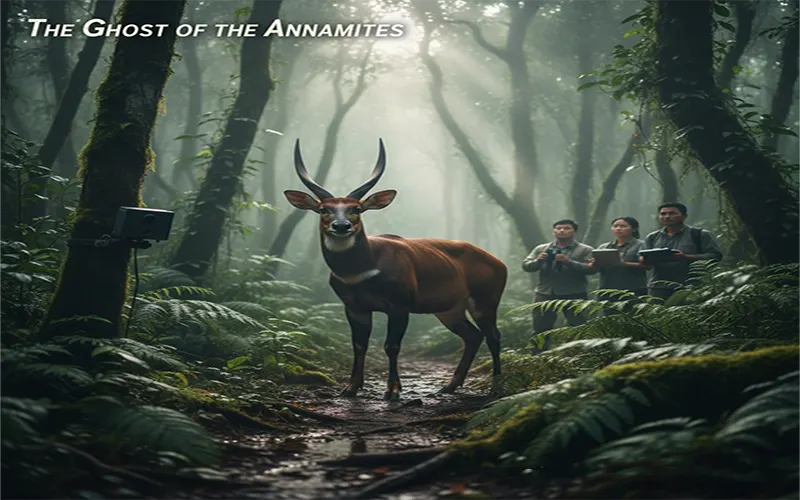
In 1992, the scientific world was shaken by the discovery of a species that had remained hidden from modern knowledge, tucked away in the mist-shrouded forests of the Annamite Mountains. This was the Saola (Pseudoryx nghetinhensis), a creature so enigmatic and rarely glimpsed that it was quickly dubbed the “Asian Unicorn.” With its dark brown coat, stark white facial markings, and two long, elegant, almost parallel horns—often reaching up to 50 cm—the Saola is a gentle, secretive mammal. Though often compared to antelopes, genetic research reveals it is actually a unique, highly specialized member of the cattle family.
The Elusive Phantom
The Saola’s habitat—a rugged, remote chain of evergreen forests along the border of Laos and Vietnam—is its greatest protection and its deepest secret. Its ability to remain undetected is legendary; despite intense efforts by researchers, there has not been a confirmed, wild sighting of a Saola since 2013. This prolonged “data void” has left conservationists scrambling to determine if any populations remain. Scientists currently estimate that the population is critically endangered, with some projections suggesting as few as 20 to 100 individuals may still survive in the wild.
The “Wall of Death”: Why the Saola is Disappearing
The Saola is not targeted by hunters directly, but it falls victim to a silent, indiscriminate threat: the wire snare. Across the Annamites, poachers set millions of cheap, easy-to-make wire loops intended to catch wild pigs and deer for the bushmeat trade. Because the Saola moves quietly through the forest floor, it frequently triggers these traps. Once ensnared, the animal cannot escape, and even a single trap can mean the end for one of the world’s rarest creatures.
Combined with this “wall of death” is the fragmentation of the forest. Road construction, agricultural expansion, and logging divide the Saola’s habitat into smaller, isolated “islands”. This isolation makes it harder for them to find mates, water, and food, while simultaneously making them more vulnerable to human encroachment.
Modern Methods of Detection and Conservation
As traditional camera trapping has struggled to yield results, conservationists are shifting to innovative detection methods:
- eDNA (Environmental DNA): Scientists are increasingly using water and soil samples from streams to detect the presence of Saola DNA, a non-invasive way to track their movements.
- Patrol Teams: Specialized teams are currently deployed to comb the forests specifically to remove these deadly wire snares, effectively clearing “safe zones” for wildlife.
- Community-Based Conservation: Recognizing that local communities are the true guardians of the forest, programs are now focusing on providing alternative livelihoods that do not rely on hunting or logging.
The Case for Intervention
Given how precarious the wild population has become, the debate over an “insurance” strategy—specifically a captive breeding program—has gained significant momentum. Experts argue that building specialized breeding centers could be the only way to prevent total extinction, with the long-term goal of releasing offspring back into secured, snare-free forests.
A Symbol of the Ecosystem
Saving the Saola is about far more than preserving a single, beautiful species; it is an indicator of the health of the entire Annamite ecosystem. The forests they call home are vital for clean water, carbon storage, and biodiversity. The story of the Saola is the story of the rainforest itself—fragile, beautiful, and desperately in need of protection. Only through unwavering international collaboration, aggressive snare removal, and the active involvement of local communities can we hope to keep the “Asian Unicorn” from becoming a myth forever.
Key Challenges vs. Current Solutions
| Key Challenges | Current Solutions |
| Indiscriminate Snaring | Deployment of specialized anti-poaching patrol teams to remove snares. |
| Habitat Fragmentation | Creation of protected zones and forest corridors to reconnect habitats. |
| Data Deficiency | Utilization of eDNA sampling and innovative monitoring to track elusive individuals. |
| Poverty-Driven Poaching | Development of alternative sustainable livelihoods for local communities. |