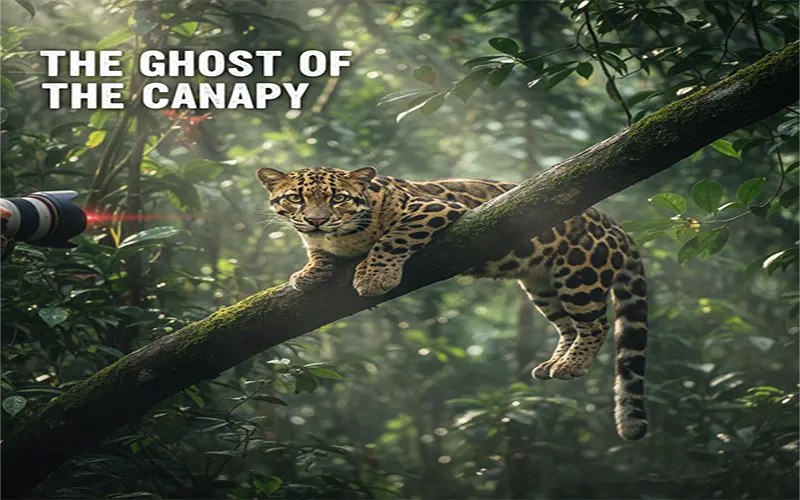
Deep within the emerald cathedrals of Southeast Asia’s rainforests, there moves a shadow so perfectly adapted to its environment that it has earned the moniker “Ghost of the Canopy.” The clouded leopard (Neofelis nebulosa and Neofelis diardi) is one of nature’s most magnificent and enigmatic predators. Unlike the tiger or the lion, which command the forest floor, the clouded leopard is an arboreal acrobat, a master of stealth whose very existence is a testament to the mysteries still held by the world’s shrinking wilderness.
The Master of Stealth
The clouded leopard is a marvel of evolutionary engineering. Its name is derived from its striking coat: large, irregular, dark-edged blotches—often called “clouds”—that allow it to blend seamlessly into the dappled light of the forest canopy.
Physically, it is built for the trees. It possesses a tail that can be as long as its body, acting as a counterbalance for high-speed chases along slender branches. Its most remarkable adaptation, however, lies in its ankles. Clouded leopards have flexible ankle joints that can rotate backward, allowing them to descend tree trunks headfirst, a feat few other big cats can replicate. Furthermore, their broad, powerful paws and sharp, curved claws provide the grip necessary to navigate the canopy with the agility of a primate.
Habitat and Distribution
Clouded leopards inhabit a vast but fragmented range, stretching from the foothills of the Himalayas through the tropical forests of mainland Southeast Asia down to the islands of Borneo and Sumatra. Despite this wide distribution, they are vanishingly rare. They are strictly nocturnal and arboreal, meaning they spend the majority of their lives high above the forest floor, far removed from the sight of humans. This behavior is their primary defense, but it has also made them one of the most poorly understood of all the world’s felids.
The Evolution of Observation
For decades, researchers relied on traditional tracking—a near-impossible task given that these cats leave little sign on the forest floor. The shift toward modern technology has revolutionized our understanding. Today, high-tech, motion-triggered camera traps have become the gold standard. When a camera trap flashes in the dark of night and captures a clouded leopard staring back, it is a scientific triumph.
Beyond optics, the field of environmental DNA (eDNA) has emerged as a game-changer. By analyzing water samples from forest streams or collecting trace biological material from leeches that have fed on jungle wildlife, researchers can now confirm the presence of clouded leopards in areas where they have never been physically spotted. These methods allow us to map their range without ever needing to disturb their solitude.
Conservation Status: A Vulnerable Guardian
Despite their mastery of the canopy, the clouded leopard is classified as Vulnerable by the IUCN. They face a “triple threat” of survival:
- Habitat Fragmentation: The rapid expansion of palm oil plantations and infrastructure development is slicing continuous rainforests into isolated islands.
- Illegal Wildlife Trade: Their beautiful pelts, bones, and teeth remain highly sought after in illegal markets, fueling poaching.
- Loss of Prey: As their habitat disappears, so does their natural prey, such as macaques and barking deer, forcing them into closer, often fatal, proximity to human settlements.
Preserving forest corridors—the “highways” of the canopy—is essential. Without these connected stretches of trees, the populations remain trapped in genetic pockets, unable to travel, breed, or hunt effectively.
The Thrill of the Sighting
To a conservationist, a confirmed sighting is more than just a data point; it is a moment of profound significance. When a camera trap catches a clouded leopard, it confirms that a forest is still healthy enough to support an apex predator. It is a validation of the hard work required to protect these landscapes. For the local trackers and scientists who spend months in the humid, leech-ridden jungles, these rare visual confirmations are the emotional fuel that keeps them in the field.
Why the Ghost Matters
The clouded leopard represents an evolutionary bridge—an animal that sits in a unique place between the small cats and the big cats of the world. Its survival is a bellwether for the health of the entire Southeast Asian rainforest. If the forest cannot sustain the Ghost of the Canopy, it is likely failing to sustain the complex web of life beneath it.
Protecting this species is not just about saving one beautiful cat; it is about ensuring that our planet’s most vital, carbon-sequestering, and biodiverse regions remain whole. To save the clouded leopard is to ensure that the forest remains a living, breathing cathedral, rather than a silent, empty shell. As we refine our technology and strengthen our conservation policies, we hold the key to ensuring that these “ghosts” continue to walk—and leap—through the mist for generations to come.