The Maine Coon is a breed of superlatives: the “gentle giant” of the feline world, known for its tufted ears, impressive size, and soulful expression. Yet, beneath that regal, plush exterior lies a breed-specific vulnerability that haunts many devoted owners: Hypertrophic Cardiomyopathy (HCM). As the most common heart disease in cats, HCM is a silent, progressive condition characterized by the thickening of the heart’s muscular walls, which eventually compromises the organ’s ability to pump blood efficiently.
For years, managing HCM was a game of “catch-up.” By the time clinical symptoms like lethargy, labored breathing, or sudden collapse appeared, the disease was often already in an advanced state. Today, however, we are entering a new era of proactive feline healthcare, where the convergence of Artificial Intelligence (AI) and precision nutrition is shifting the paradigm from reactive treatment to preemptive care.
The Maine Coon’s Achilles Heel: HCM
In Maine Coons, HCM often has a hereditary component, with specific genetic mutations—most notably in the MYBPC3 gene—implicated in the development of the disease. Because the heart muscle thickens slowly, the condition is notoriously asymptomatic in its early stages. A Maine Coon may appear perfectly healthy, playing and purring, while its heart is undergoing subtle, structural changes. Traditionally, detection relied on sporadic echocardiograms (ultrasounds of the heart) conducted at veterinary check-ups. While invaluable, these snapshots do not capture the day-to-day fluctuations or the subtle, early-warning signals of the heart’s struggle.
The Rise of AI Wearable Tracking
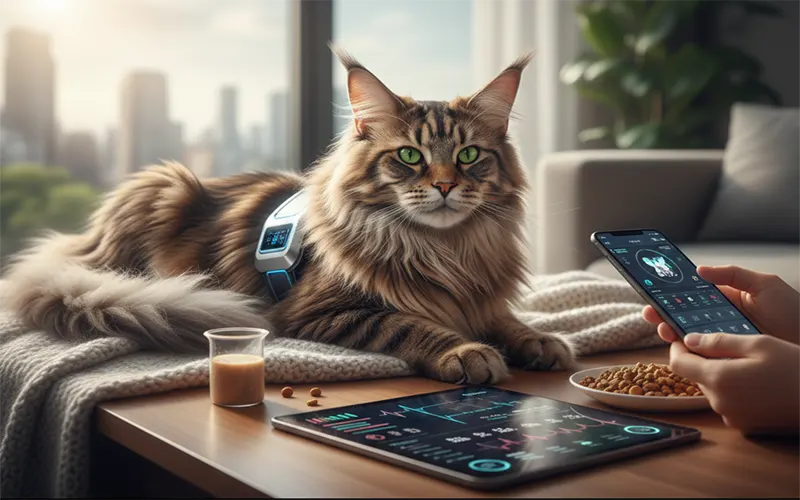
This is where AI-driven wearable technology—such as smart collars or lightweight monitoring vests—is becoming a game-changer. These devices do more than just track movement; they act as a 24/7 diagnostic bridge between the home and the clinic.
- Continuous Monitoring: AI-powered wearables monitor vital metrics, including resting heart rate, respiratory rate, sleep quality, and activity intensity.
- The Power of AI Algorithms: The true innovation lies in the AI’s ability to identify “baselines.” By learning the specific rhythms of an individual cat, the AI can detect minute deviations. For instance, a persistent, slight increase in a sleeping respiratory rate—invisible to the naked eye—can be a critical red flag for early-stage congestive heart failure.
- The Hypothetical Scenario: Consider “Leo,” a five-year-old Maine Coon. His smart collar notes that his average nighttime respiratory rate has crept up from 22 to 26 breaths per minute over two weeks. Simultaneously, the AI notices a decrease in his overall activity levels. It triggers an automated alert to his owner: “Subtle change in vital signs detected; consultation with your veterinarian recommended.” Because of this early notification, Leo’s owner brings him in for an echocardiogram before he shows any outward signs of distress, allowing the vet to start therapeutic management years earlier than would have otherwise been possible.
Precision Nutrition: Tailoring the Diet
If wearables are the “early warning system,” precision nutrition is the “support infrastructure.” Traditional cat food is often a generalized solution, but the heart of an HCM-vulnerable Maine Coon requires targeted support.
- Key Nutrients: A heart-healthy diet for a Maine Coon often focuses on specific cardiovascular support. Taurine is essential for maintaining cardiac muscle health, while L-Carnitine aids in energy metabolism within the heart cells. Omega-3 fatty acids (EPA and DHA) are vital for reducing inflammation, and CoQ10 acts as a powerful antioxidant that supports mitochondrial function in the heart muscle.
- AI-Enhanced Personalization: Precision nutrition goes beyond these nutrients; it is about individualization. AI platforms can integrate data from a cat’s wearable device with its genetic test results and blood panels to recommend specific dietary formulations. If the wearable indicates that a cat’s activity level is decreasing, the AI might suggest an adjustment in caloric density to prevent weight gain, which would put additional strain on the heart.
- Custom Formulations: We are moving toward a future where AI synthesizes data to help veterinary nutritionists design diets that adapt to the disease’s progression. As the heart’s needs change, the micronutrient profile of the food can be dynamically adjusted, ensuring the Maine Coon is always receiving exactly what it needs to optimize cardiac function.
Integration and Collaboration
It is critical to emphasize that AI and wearables are tools to enhance, not replace, veterinary medicine. Data is only useful when interpreted by a qualified professional. The future of Maine Coon health lies in a seamless digital ecosystem where wearables transmit data directly to veterinary medical records. This collaboration allows veterinarians to move from making decisions based on 15-minute exams to making decisions based on weeks of continuous, longitudinal data.
Challenges and the Future
The path forward is not without challenges. These technologies are currently expensive, and data accuracy remains a focus for developers. Regulatory hurdles regarding data privacy and clinical validation of AI diagnostic tools must also be navigated.
However, the outlook is undeniably optimistic. By combining the “eyes and ears” of AI with the “fuel” of precision nutrition, we are granting Maine Coon owners the gift of time. We are transforming the management of HCM from a frightening diagnostic surprise into a controlled, proactive process. For the majestic Maine Coon, this technology means more years of health, more play, and more purrs, ensuring these gentle giants remain the vibrant hearts of our homes for as long as possible.